
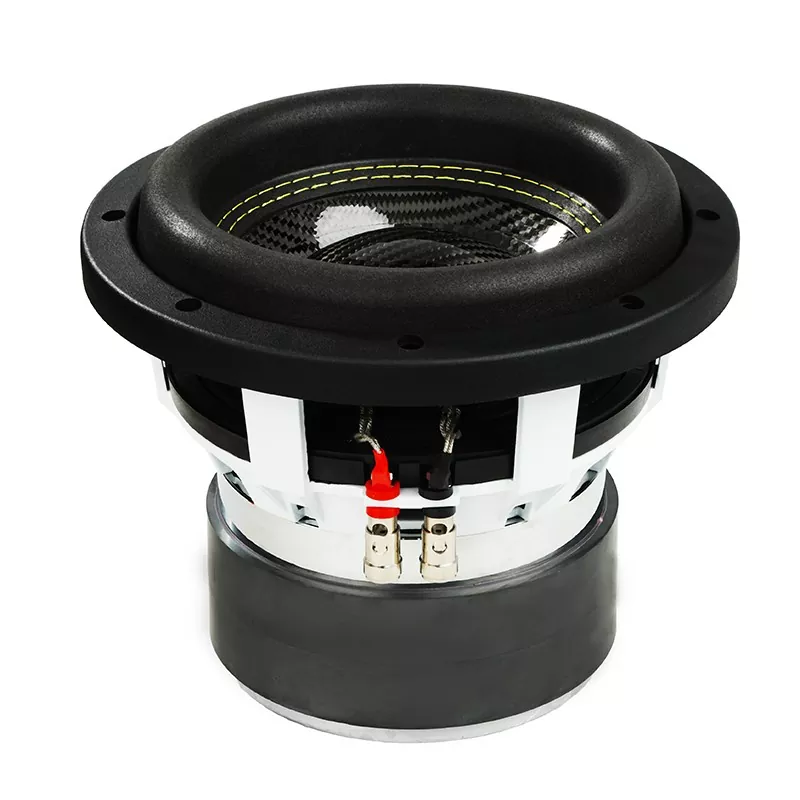
Rodrock Enterprises provides high-performance car audio solutions for drivers and audio builders seeking stronger, cleaner low-frequency output. An 8-inch Carbon Fiber Car Speaker combines a rigid carbon fiber diaphragm, 1200W peak power, 300W RMS power, and a 37Hz–1200Hz frequency range, making it a practical choice for upgrading bass performance in space-conscious vehicle installations.
Choosing the right car subwoofer involves more than simply comparing power ratings. Cone material, impedance, sensitivity, voice coil construction, magnet strength, frequency response, and installation depth all influence real-world performance. The 8-inch Carbon Fiber Car Speaker is designed around these key factors, using a carbon fiber diaphragm, Φ61 copper-clad aluminum voice coil, and 102.5oz magnet. With 2Ω + 2Ω dual impedance, 1200W maximum power, 300W RMS power, 87dB sensitivity, and a 37Hz–1200Hz frequency response, it offers a balanced solution for enthusiasts who want deep bass without moving immediately to a much larger subwoofer.
What Is an 8-inch Carbon Fiber Car Speaker?
What Are the Key Specifications?
Why Does Carbon Fiber Matter for Sound Performance?
How Do Power and Impedance Affect System Matching?
What Should You Consider Before Installation?
Where Can This Speaker Be Used?
How Does It Compare with Other Speaker Materials?
How Should You Choose the Right Speaker?
An 8-inch Carbon Fiber Car Speaker is a compact high-power subwoofer designed to reproduce the lower portion of the audio spectrum with greater impact and control. Its 8-inch format provides a useful balance between acoustic output and installation space, particularly for vehicles where trunk or enclosure volume is limited.
The model referenced by Rodrock uses a carbon fiber cone, a Φ61 copper-clad aluminum voice coil, and a 102.5oz magnet. These components work together to provide the mechanical stiffness and electromagnetic driving force required for powerful bass reproduction.
Its rated specifications include 1200W maximum power, 300W RMS power, 2Ω + 2Ω impedance, 87dB sensitivity, and a frequency response from 37Hz to 1200Hz. The 151mm mounting depth should also be considered during enclosure and vehicle installation planning.
Technical specifications help installers and buyers determine whether a speaker is appropriate for a particular amplifier and vehicle enclosure. Rather than focusing on one number, evaluate the complete system relationship between power, impedance, sensitivity, frequency range, and physical dimensions.
| Specification | Value | Why It Matters |
|---|---|---|
| Speaker Size | 8 inches | Balances bass output and installation space |
| Peak Power | 1200W | Indicates maximum short-duration power capability |
| RMS Power | 300W | More useful for continuous system power matching |
| Impedance | 2Ω + 2Ω | Provides flexible amplifier configuration options |
| Frequency Response | 37Hz–1200Hz | Supports strong low-frequency reproduction |
| Sensitivity | 87dB | Helps indicate acoustic output for a given input level |
| Voice Coil | Φ61 CCAW | Supports high-power operation while controlling moving mass |
| Magnet | 102.5oz | Provides strong electromagnetic driving force |
| Mounting Depth | 151mm | Important for enclosure and vehicle fitment |
The diaphragm is one of the most important moving components in a speaker. It must move rapidly in response to the electrical signal while maintaining its intended shape. Excessive deformation can reduce control and introduce unwanted coloration or distortion.
Carbon fiber is attractive for speaker diaphragms because it combines high rigidity with relatively low weight. In a high-power application, this characteristic can help the cone maintain structural stability as excursion and acoustic demands increase.
For buyers comparing cone materials, carbon fiber can therefore be an attractive option when durability, stiffness, and high-power bass performance are important priorities.
Power matching is essential when building a reliable car audio system. A speaker's maximum power figure should not be treated as the recommended continuous amplifier output. For this model, the 300W RMS rating is particularly relevant when evaluating an amplifier for sustained operation.
The dual 2Ω + 2Ω impedance configuration also provides greater flexibility for system design. Depending on the amplifier and wiring arrangement, installers can configure the voice coils according to the electrical requirements of the system.
Before installation, check:
Correct electrical matching is more important than simply choosing the amplifier with the highest advertised wattage.
A high-performance speaker can only perform as intended when its mechanical installation is properly planned. The referenced model has a 151mm mounting depth, so the available installation space should be measured before purchasing or fabricating an enclosure.
Measure the mounting depth, cutout area, enclosure dimensions, and surrounding clearance. Make sure the cone and suspension have sufficient room to move without contacting other vehicle components.
The enclosure has a direct influence on bass behavior. Depending on the desired response and application, a sealed or ported enclosure may be considered. The final enclosure should follow appropriate acoustic calculations rather than being selected only according to external dimensions.
Carbon fiber provides a strong diaphragm structure, but the cone should still be protected from sharp objects, excessive moisture, and accidental physical impact during installation and vehicle use.
An 8-inch high-power subwoofer is suitable for applications where stronger bass is required without automatically moving to a 10-inch, 12-inch, or larger driver.
Its compact footprint can be especially useful for vehicles where preserving passenger or cargo space is an important consideration.
Speaker cone materials each involve different engineering trade-offs. Paper can provide a natural acoustic character and low moving mass, while polypropylene is often selected for durability and general-purpose applications. Carbon fiber is commonly considered when stiffness and high-power handling are key priorities.
| Cone Material | Typical Strength | Potential Application |
|---|---|---|
| Paper | Low mass and responsive movement | General-purpose and traditional audio designs |
| PP | Durability and moisture resistance | Everyday automotive applications |
| Glass Fiber | Good rigidity-to-weight balance | Performance-oriented speaker systems |
| Carbon Fiber | High rigidity and structural stability | High-power and performance-focused audio systems |
The best material depends on the intended sound profile, amplifier configuration, installation environment, enclosure design, and budget. Material alone does not determine overall sound quality.
For buyers sourcing an 8-inch speaker for a new vehicle audio project, evaluate the complete specification sheet rather than relying on peak wattage alone.
Rodrock's product information also highlights installation adaptation guidance, remote technical support, and customization options such as additional shock absorber pads. These services can be useful for buyers developing customized vehicle audio solutions.
Yes. With a 37Hz–1200Hz frequency response, 300W RMS power rating, 1200W peak power capability, and carbon fiber diaphragm, this type of speaker is designed for powerful low-frequency reproduction and can be integrated into bass-focused vehicle audio systems.
The amplifier should be selected according to the speaker's RMS rating and impedance configuration. The referenced model is rated at 300W RMS and uses a 2Ω + 2Ω dual-impedance design. Always verify the amplifier's output at the intended final impedance before installation.
Carbon fiber offers high rigidity and low deformation characteristics. These properties can help the diaphragm maintain structural stability during high-power operation, supporting controlled cone movement.
It indicates a dual-voice-coil configuration in which each voice coil has a nominal 2Ω impedance. The final wiring configuration affects the overall impedance presented to the amplifier, so the installation should follow the amplifier manufacturer's electrical requirements.
The specified mounting depth is 151mm. In addition to depth, installers should allow adequate clearance around the speaker and ensure that the enclosure dimensions and mounting structure are appropriate for the vehicle.
The right car speaker should combine suitable acoustic performance, electrical compatibility, mechanical fit, and dependable construction. With its 8-inch format, 1200W peak power, 300W RMS rating, 2Ω + 2Ω impedance, carbon fiber diaphragm, Φ61 voice coil, 102.5oz magnet, and 37Hz–1200Hz frequency response, this speaker provides a compelling option for performance-oriented automotive audio upgrades where strong bass and efficient use of installation space matter.
Whether you are developing a custom car audio system, sourcing speakers for an aftermarket project, or evaluating a China car audio supplier for your market, careful specification matching is the foundation of a reliable installation. For technical specifications, customization requirements, amplifier matching, or bulk purchasing information, contact us to discuss a suitable car audio solution for your application.
-