
A family car, less than 5 meters long and only 1.5 meters wide, contains a 5-kilometer-long wiring harness, weighing about 5% of the car's weight, or approximately 25 kilograms. This harness wraps around the car 384 times, connecting 20,000 to 30,000 parts and bearing the core responsibility of power supply and signal transmission.
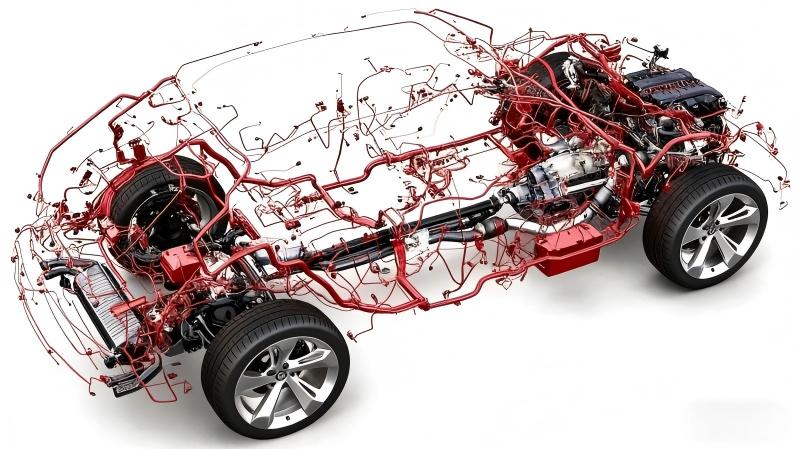
1. automobiles have complex functions, layouts, and structures. A car can have as many as 20,000 to 30,000 parts. Connecting so many components together inevitably requires a large number of wiring harnesses.
2. The interior space of a car is a complex three-dimensional structure. To meet the requirements of fire prevention or concealment, many wiring harnesses have to "take detours", which increases the actual length of the wiring harnesses.
3. At the same time, for redundancy and scalability design, manufacturers also leave margin when arranging wire harnesses, further increasing the length of the wire harnesses.
4. On the other hand, the level of standardization is low. There are more than 200 types, and due to the lack of a unified standard, different wire harnesses need to be equipped with different connectors. In some cases, the wire harness may even need to be designed with more branches and adapters, which increases the number of steps and complexity of wiring.
Based on the above analysis, it can be seen that the fundamental task in reducing wiring harnesses is to optimize the vehicle's architecture.
1. The negative impacts of excessively long wiring harnesses have already permeated the entire lifecycle of automobile production, use, and maintenance. On the production side, the densely packed wiring harnesses can only be installed manually, and the processes of splicing, drilling, and wiring are time-consuming and labor-intensive, directly reducing production efficiency and increasing manufacturing costs.
2. On the user side, crowded and stacked wire harnesses not only hinder heat dissipation but may also cause signal interference. Each additional wire harness means two more connection points, doubling the risk of loosening and failure.
3. More importantly, wiring harnesses account for 3%-5% of the weight of a vehicle. Based on the global production of 93.55 million vehicles in 2023, even a 1% reduction in weight per vehicle would have a cumulative energy efficiency improvement effect that would be enough to influence the development trajectory of the entire industry.
1. Faced with this predicament, leading global automakers have embarked on technological exploration. Tesla's breakthrough is of great significance: by promoting the transformation of electronic and electrical architecture from distributed to centralized , integrating systems such as the body and chassis into four major modules, allowing wiring harnesses such as door controls to "connect locally" rather than going to the central control center, and simplifying more than 200 connectors into 6 standard interfaces, the length of the Model 3 wiring harness has been successfully reduced to 1.5 kilometers, and the Cybertruck has achieved a 77% reduction, with a total length of less than 1 kilometer. Its ultimate goal is to shorten the wiring harness to 100 meters, completely breaking down the barriers to automated production.
2. Domestic automakers are not to be outdone. Leapmotor 's " Clover " central integrated architecture uses one SOC chip and one MCU chip to achieve central supercomputing, integrating four functional domains: cockpit, intelligent driving, power, and body. This keeps the total wiring harness length within 1.5 kilometers and reduces weight by 15 kilograms compared to traditional solutions. Li Auto reuses control modules through patented technology to reduce communication wiring harness deployment. BYD optimizes its high-voltage system architecture, reducing the amount of connectors and cables used. These explorations fully demonstrate that simplifying wiring harnesses at the technical level is not a difficult problem, but the real bottleneck in industry development has emerged—the lack of standardized protocols.
If each automaker implements its own dedicated wiring harness solution, the market will inevitably see a wide variety of wiring harness and connector specifications. This will not only hinder large-scale automated production but also impede collaborative innovation across the industry chain, making economies of scale impossible. This dilemma is also evident in the battery swapping sector : the different sizes and structures of batteries from different brands make it difficult for swapping stations to be compatible with multiple vehicle models, severely restricting operational efficiency and infrastructure sharing.
This is why leading companies in the industry have begun to proactively promote standardization. Tesla has publicly released its electronic wiring harness interface design, inviting equipment suppliers and automakers to participate in the standard setting. NO, on the other hand, has joined forces with major automakers such as FAW , GAC, and Changan, as well as energy institutions such as China Southern Power Grid, to break down brand barriers and actively participate in the formulation of national battery swapping safety and construction standards, using its own technological accumulation to promote the implementation of industry standards.
From 5 kilometers to 100 meters is essentially a microcosm of an efficiency revolution; while the shift from a bewildering array of interfaces to a unified standard is the core secret to industrial upgrading.